Shab-e-Barat 2027 Date in Pakistan — 15 Sha’ban 1448
Shab-e-Barat, the night of 15 Sha’ban, is one of the most widely observed nights in Pakistan. In 2027, Shab-e-Barat is expected to fall on the night of Saturday, 23 January to Sunday, 24 January 2027 (15 Sha’ban 1448 AH) — subject to the official moon sighting by the Ruet-e-Hilal Committee in Pakistan.
On this night, Muslims visit mosques, pray for forgiveness, remember loved ones who have passed away, and prepare spiritually for the month of Ramadan that follows. This guide covers the expected date, the significance of the night, and how it is observed in Pakistan.
Islamic events are chapters of the seerah, not just holidays — each date carries a story that shaped the ummah. But many Muslims observe the dates without knowing the stories, or follow customs without knowing the evidence. This guide restores both: the history behind each occasion and the authentic way to honor it.
Quick Answer
Shab-e-Barat 2027 in Pakistan is expected on the night of 23-24 January 2027 (15 Sha’ban 1448 AH). The date is expected — the Ruet-e-Hilal Committee confirms it after the moon sighting.
Key Facts at a Glance
- **January 9, 2027:** Saturday
- **January 24, 2027:** Sunday
- **February 6, 2027:** Saturday
- **February 8, 2027:** Monday
Key Takeaways
- Shab-e-Barat 2027 in Pakistan is expected on the night of 23-24 January 2027 (15 Sha’ban 1448 AH).
- The date is expected — the Ruet-e-Hilal Committee confirms it after the moon sighting.
- It is known as the night of forgiveness and a time to prepare for Ramadan.
- Common observances include nafl prayers, Quran recitation, dua, and visiting graveyards.
What Is Shab-e-Barat?
Shab-e-Barat means the ‘Night of Forgiveness’ or the ‘Night of Salvation’. It falls on the night of 15 Sha’ban, the middle of the eighth Hijri month. Several narrations mention Allah’s abundant mercy on this night, and scholars across the Muslim world have long regarded it as a night of special forgiveness — though scholars differ on the grading of individual narrations about it.
For Muslims in Pakistan, Shab-e-Barat is deeply woven into family and community life. It is a night to seek forgiveness for past sins, pray for deceased relatives, and make a fresh spiritual start before Ramadan begins two weeks later.
Shab-e-Barat 2027 Date in Pakistan
In 2027, 15 Sha’ban 1448 AH is expected to fall on Sunday, 24 January 2027, which means the night of Shab-e-Barat begins after sunset on Saturday, 23 January and continues until dawn on Sunday, 24 January. The date is expected — the Ruet-e-Hilal Committee will confirm the start of Sha’ban 1448 after the moon sighting, and the date could shift by a day.
Pakistan announces its own Hijri dates, which sometimes differ by one day from Saudi Arabia. In recent years, Pakistan has often been one day behind the Saudi calendar, so always follow the official Pakistani announcement for the correct night.
- 1 Sha’ban 1448 — expected 10 January 2027
- 15 Sha’ban 1448 (Shab-e-Barat) — night of 23-24 January 2027
- 29 Sha’ban 1448 — expected 7 February 2027 (Ramadan moon sighting night)
- 1 Ramadan 1448 — expected 8 February 2027
How Shab-e-Barat Is Observed in Pakistan
Mosques across Pakistan stay open late on Shab-e-Barat, with worshippers offering nafl prayers, reciting the Quran, and making long duas. Many families visit graveyards in the evening to pray for their deceased relatives — a deeply rooted tradition in the country. Sweets such as halwa are often prepared and shared with neighbours and the poor.
Some Muslims fast on the day of 15 Sha’ban. Fasting in Sha’ban in general is well established — the Prophet (PBUH) fasted more in Sha’ban than in any other month besides Ramadan (Sahih Bukhari, Sahih Muslim). The night itself has no single prescribed prayer in authentic sources, so general worship is the best way to spend it.
Preparing for Ramadan After Shab-e-Barat
Shab-e-Barat falls just two weeks before Ramadan, and wise Muslims use it as a starting point for Ramadan preparation. This is the time to make up any missed fasts from last Ramadan, increase Quran recitation, and set spiritual goals for the coming month. The Prophet (PBUH) used Sha’ban to prepare for Ramadan through extra fasting — a practice worth following.
Use the days after Shab-e-Barat to plan your Ramadan: arrange your prayer schedule, set a Quran reading target, and clear worldly commitments where possible. Arriving at Ramadan already in the habit of worship makes the blessed month far more rewarding.
The Seerah Context: Why These Dates Matter
Islamic events are not anniversaries for nostalgia — they are chapters of the seerah (Prophetic biography) that shaped the ummah. Each sacred date anchors a turning point: the Hijra marks Islam’s transformation from persecuted faith to organized community; Badr (17 Ramadan 2 AH) proved that 313 fasting believers with divine aid could overcome a thousand; the conquest of Makkah (20 Ramadan 8 AH) demonstrated mercy in victory; Hudaybiyyah (6 AH) showed that strategic patience outperforms force; and the Farewell Sermon (10 AH) delivered Islam’s charter of human dignity.
The Quran itself ties worship to history: Ramadan’s fast honors the month ‘in which the Quran was revealed’ (2:185); Hajj‘s rites reenact Ibrahim’s (AS) devotion; Ashura‘s fast commemorates Musa’s (AS) rescue. When we observe these dates, we are not merely remembering — we are *participating* in a 1,400-year continuum. The companions lived these events; we inherit their lessons.
Study the seerah around each event and the date comes alive. Read the story of the cave of Thawr before Muharram; the Farewell Sermon before Arafat; the first revelation before Ramadan’s 17th night. Dates without stories are numbers; with stories, they become identity. Our history articles walk through each event in full — use them as companions to the calendar.
How Different Cultures Observe These Events
The same sacred date wears different cultural dress across the ummah — and this diversity is a strength, not a problem. **Mawlid** (12 Rabi al-Awwal) is a public holiday with mosque programs across the Muslim world, while scholarly views on organized celebrations differ — both positions have qualified scholarship; mutual respect is the Prophetic way. **Shab-e-Barat** (15 Sha’ban) glows with night worship across South Asia; **Shab-e-Meraj** (27 Rajab) fills mosques in Turkey, Pakistan, and beyond with seerah programs on the ascension.
**Ashura** carries two dimensions: gratitude for Musa’s (AS) rescue (marked by fasting, per Sahih Muslim) and, especially in Shia tradition, profound mourning for Imam Hussain (RA) at Karbala — though Sunnis too grieve the tragedy deeply. **Chaand Raat** (the Shawwal crescent night) turns South Asian markets into festivals; **Eid** itself is celebrated with local foods, dress, and customs from Morocco’s couscous to Indonesia’s ketupat.
The rule for navigating differences: **distinguish the authentic core from cultural expression**. The core — fasting Ashura, praying Eid, honoring the Prophet (PBUH) — is shared. Cultural forms vary legitimately. Never declare fellow Muslims deviant over customs that scholars differ on; and never elevate custom above the Sunnah. Unity in essentials, respect in differences — that is the ummah’s way.
Teaching Children About Islamic Events
Children remember stories, not dates — so anchor every Islamic event in its story. For **Mawlid**, tell the Year of the Elephant and the Prophet’s (PBUH) childhood. For **Isra and Mi’raj**, describe Buraq, the heavens, and the gift of salah — children love the wonder. For **Badr**, the 313 against 1,000 captivates every young heart. For **Karbala**, teach Hussain’s (RA) courage against tyranny in age-appropriate terms.
**Make it experiential:** take children moon-sighting on the 29th evening; let them hear the Eid takbeer and join the Eid prayer; involve them in packing qurbani meat for the poor; light a lantern for Ramadan. **Make it rhythmic:** a family calendar marking Islamic dates, a nightly ‘seerah minute’ in Ramadan, salawat together on Fridays. **Make it joyful:** Islamic events should feel like the best days of the year — gifts, special foods, family gatherings — so children associate the deen with happiness, not obligation.
Above all, model it: children adopt what they see. If parents fast Ashura, attend Eid prayer, and speak of the Prophet (PBUH) with love, children absorb the calendar’s meaning effortlessly. The goal is not memorized dates but a lived identity — young Muslims who *feel* the Hijri year turning.
The Islamic Year at a Glance: Every Major Event Month by Month
**Muharram:** Islamic New Year (1st); Ashura (10th) — fasting and Karbala’s memory. **Safar:** historically the month of the Hijra’s journey; no special observance — a month for steady worship free of superstition. **Rabi al-Awwal:** Mawlid (12th) — the Prophet’s (PBUH) birth, marked with seerah study and salawat. **Rabi al-Thani:** quiet consolidation — deepen the habits Mawlid inspired.
**Jumada al-Ula/Akhirah:** the year’s quiet quarter — ideal for white-days fasting and Quran goals. **Rajab:** Isra and Mi’raj (27th) — the Night Journey; increase istighfar as Ramadan approaches. **Sha’ban:** Shab-e-Barat (15th) — the night of forgiveness; the Prophet (PBUH) fasted most of this month. **Ramadan:** fasting, Taraweeh, Laylat al-Qadr (odd nights of the last ten), Badr (17th), conquest of Makkah (20th).
**Shawwal:** Eid al-Fitr (1st); six fasts of Shawwal. **Dhul Qa’dah:** sacred month; Hudaybiyyah’s anniversary (6 AH) — reflect on strategic patience. **Dhul Hijjah:** the first ten days (best days of the year); Arafat (9th) — fasting expiates two years; Eid al-Adha (10th); Tashreeq (11th–13th). Twelve months, one rhythm: worship, history, and community woven into time itself.
Sunnah vs Cultural Innovation: A Balanced Guide
Around Islamic events, a sensitive question recurs: which practices are Sunnah and which are later additions? Islam’s framework is clear: worship requires textual evidence — ‘whoever introduces into this affair of ours what is not of it, it is rejected’ (Sahih al-Bukhari, Sahih Muslim). Yet culture is not the enemy — the Prophet (PBUH) affirmed beautiful customs that don’t contradict revelation.
**The balanced method:** (1) Identify the *authentic core* — what Quran and Sunnah establish for the occasion (e.g., fasting Ashura, Eid prayer, honoring the Prophet (PBUH) daily). (2) Welcome *neutral customs* — foods, dress, gatherings — as cultural expression, not worship. (3) Question *ritualized additions* presented as religious requirements without evidence — gently, with knowledge, not harshness. (4) Respect *scholarly difference* — where qualified scholars differ (e.g., Mawlid gatherings), don’t declare fellow Muslims deviant.
**Tone matters most.** The companions corrected with wisdom and love. Harshness over disputed matters has divided more communities than any innovation ever did. Focus energy on reviving *agreed* Sunnahs — most Muslims neglect established practices while debating disputed ones. A community alive with Quran, prayer, charity, and good character has little to fear from cultural color — and much to gain from unity.
Friday (Jumu’ah): The Weekly Eid
Before the annual Eids, there’s a weekly one: **Jumu’ah**. The Prophet (PBUH) said, ‘The best day on which the sun has risen is Friday’ (Sahih Muslim) — the day Adam (AS) was created, entered Paradise, and the Hour will come. Every week, Muslims get a mini-Eid: congregational prayer, a khutbah, and an hour when duas are answered.
**Friday Sunnahs:** ghusl (Sahih al-Bukhari), best clothes, perfume, early arrival at the mosque (‘whoever comes early, it is as if he sacrificed a camel…’ — the famous hadith of descending rewards, Sahih al-Bukhari), Surah Al-Kahf recitation (‘light between the two Fridays’ — Hakim, Bayhaqi), abundant salawat on the Prophet (PBUH), and seeking the **hour of acceptance** — most scholars place it in the last hour before Maghrib (Sahih al-Bukhari, Sahih Muslim mention an hour on Friday when dua is answered).
**The khutbah’s purpose:** a weekly spiritual recharge and community address — listen attentively (speaking during it nullifies the reward — Sahih al-Bukhari). **For the family:** make Friday special — a nicer meal, no major arguments, early bedtime Thursday. Children should experience Jumu’ah as the week’s highlight. In a life of deadlines, Friday is Allah’s weekly reset button — the recurring Islamic ‘event’ that shapes all others.
Did You Know?
- 12 Rabi al-Awwal: The Prophet’s (PBUH) birthday and — per the majority view — the date of his passing: a day of joy and reflection intertwined.
- 27 Rajab: The observed date of the Mi’raj — the night that gave the ummah its five daily prayers.
- 10 Muharram: One date, two histories: Musa’s (AS) rescue and Hussain’s (RA) martyrdom — gratitude and grief together.
- Weekly Eid: Friday is the Muslims’ weekly Eid — ‘the best day on which the sun has risen’ (Sahih Muslim).
- Hour of acceptance: An hour on Friday when dua is answered — most scholars place it in the last hour before Maghrib.
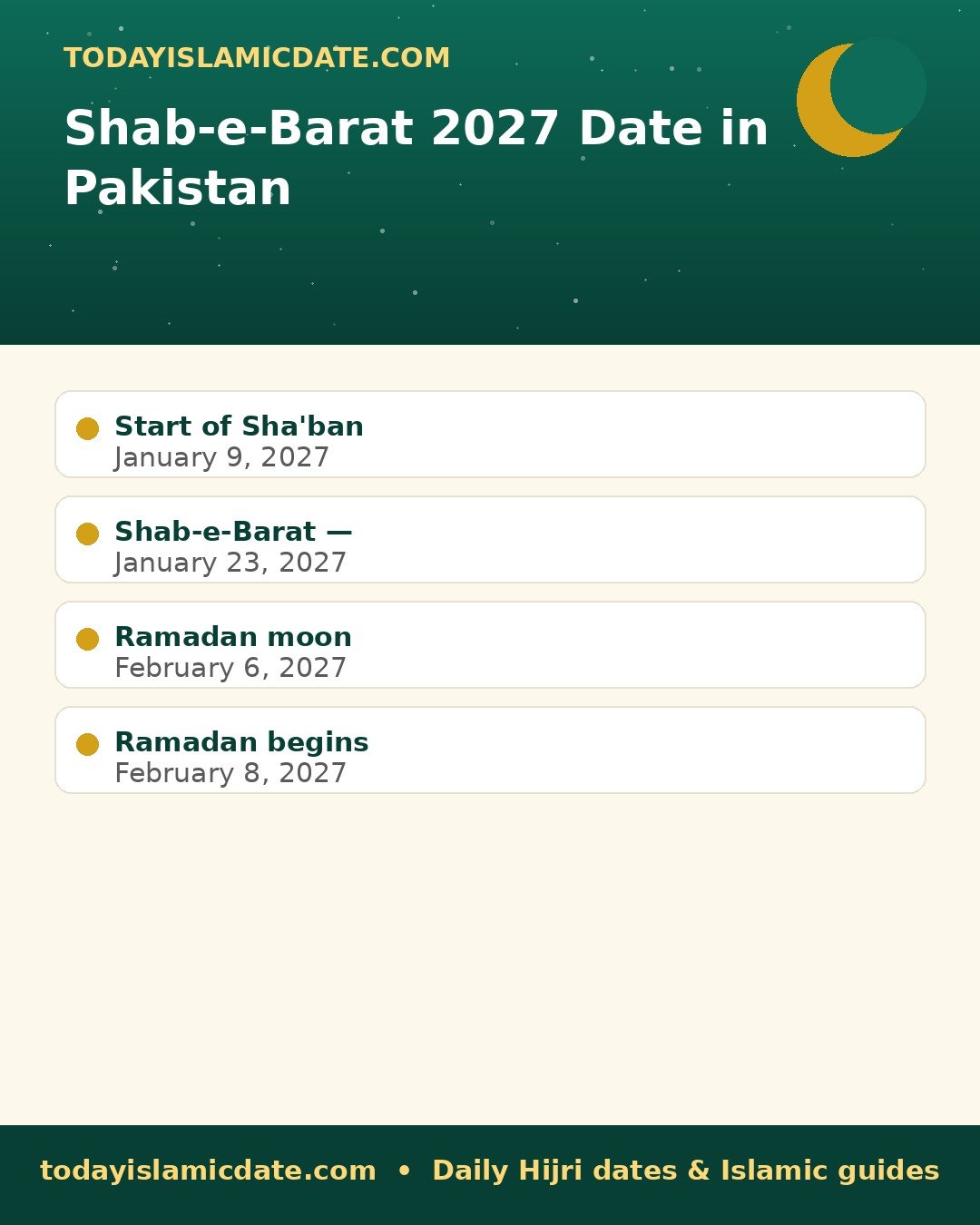
Sha’ban 1448 AH — Expected Dates in Pakistan (2027)
Expected dates for Sha’ban 1448 in Pakistan. All dates are expected and subject to the Ruet-e-Hilal moon sighting:
| Date (Expected) | Day | Hijri Date | Event |
|---|---|---|---|
| January 9, 2027 | Saturday | 1 Sha’ban 1448 | Start of Sha’ban 1448 |
| January 24, 2027 | Sunday | 15 Sha’ban 1448 | Shab-e-Barat — Night of Forgiveness (night of 23-24 Jan) |
| February 6, 2027 | Saturday | 29 Sha’ban 1448 | Ramadan moon sighting night |
| February 8, 2027 | Monday | 1 Ramadan 1448 | Ramadan begins (expected) |
Key Terms Glossary
- **Mawlid** — the Prophet’s (PBUH) birthday, observed 12 Rabi al-Awwal by many Muslims.
- **Isra and Mi’raj** — the Night Journey and Ascension, observed 27 Rajab.
- **Shab-e-Barat** — the 15th night of Sha’ban — ‘the night of absolution.’
- **Ashura** — the 10th of Muharram — fasting day and Karbala’s anniversary.
- **Laylat al-Qadr** — the Night of Decree — better than a thousand months (97:1–3).
- **Chaand Raat** — South Asian term for the crescent night before Eid.
- **Seerah** — the Prophet’s (PBUH) biography — the story behind every Islamic event.
- **Bid’ah** — religious innovation — introducing worship without textual evidence.
Common Mistakes to Avoid
- **Treating cultural customs as religious obligations:** enjoy traditions, but don’t present them as Sunnah — distinguish culture from worship.
- **Ignoring the event’s story:** observing a date without knowing its history empties it of meaning — learn the seerah behind each occasion.
- **Sectarian mocking:** differing observances (e.g., Mawlid, Ashura practices) reflect scholarly diversity — mockery divides the ummah.
- **Missing the worship for the celebration:** feasts and gatherings are beautiful, but don’t let them eclipse the prayer, fasting, and dua at the event’s heart.
- **Only learning your own tradition:** explore how Muslims worldwide observe — it deepens appreciation of the ummah’s richness.
Frequently Asked Questions
When is Shab-e-Barat 2027 in Pakistan?
Shab-e-Barat 2027 in Pakistan is expected on the night of Saturday, 23 January to Sunday, 24 January 2027 (15 Sha’ban 1448 AH), subject to the Ruet-e-Hilal moon sighting.
Is Shab-e-Barat a public holiday in Pakistan?
Shab-e-Barat is not a public holiday in Pakistan, but mosques hold special programmes and many people spend the night in worship.
Is there a special prayer for Shab-e-Barat?
There is no single prescribed prayer for Shab-e-Barat in authentic sources. The night is best spent in general worship — nafl prayers, Quran recitation, dhikr, and dua.
Should I fast on 15 Sha’ban?
Fasting on 15 Sha’ban is voluntary. Fasting in Sha’ban generally is well established from the Prophet’s practice, but no specific fast is obligatory on this day.
Why do people visit graveyards on Shab-e-Barat?
Visiting graves to pray for the deceased is a long-standing tradition in Pakistan on this night, as families remember loved ones and pray for their forgiveness.
Why do Muslims celebrate Mawlid?
To honor the birth of Prophet Muhammad (PBUH) on 12 Rabi al-Awwal with seerah study, salawat, poetry, and charity. Scholars differ on organized celebrations — many permit them as expressions of love; others prefer expressing love through daily Sunnah. Both views deserve respect.
What happened on 27 Rajab?
The Night Journey and Ascension (Isra and Mi’raj) is widely observed on 27 Rajab — the Prophet’s (PBUH) miraculous journey to Al-Aqsa and through the heavens, where the five daily prayers were ordained (Quran 17:1).
Why is Ashura significant?
Two dimensions: Allah’s rescue of Musa (AS) from Pharaoh — marked by fasting that expiates a year’s sins (Sahih Muslim); and the martyrdom of Imam Hussain (RA) at Karbala (61 AH), mourned deeply across the ummah.
How should I observe Islamic events?
Learn the event’s story, perform its worship (fasting, prayer, dua), give charity, teach your family, and celebrate joyfully — keeping the authentic core central and cultural expressions in their place.
Should I fast on Shab-e-Barat?
The 15th of Sha’ban’s virtue is reported in Ibn Majah; scholars differ on the narration’s strength. Fasting it as a voluntary fast is permissible — many scholars recommend it within the month’s general encouragement of fasting. Avoid treating weak narrations as certain.
How is Mawlid celebrated around the world?
Mosque programs with seerah lectures, salawat, poetry (qasidas), charity meals, and processions in some countries — it’s a public holiday across much of the Muslim world. Practices vary by culture and scholarly view.
What is Chaand Raat?
The ‘night of the moon’ — South Asian celebration of the Shawwal crescent sighting, with markets, henna, and festivities heralding Eid al-Fitr the next morning.
Are cultural Eid customs allowed?
Yes — foods, dress, decorations, and gatherings are permissible cultural expressions. They become problematic only when presented as religious obligations without evidence, or when they involve prohibited elements.
Sources & How This Article Was Researched
Every guide on TodayIslamicDate.com is researched from primary Islamic sources — the Holy Quran and the authentic hadith collections — combined with astronomical data for date projections.
Our editorial process: (1) gather evidence from the Quran and hadith, (2) cross-check historical dates across multiple references, (3) compute expected Gregorian dates from lunar astronomy, (4) review for accuracy and balanced presentation of scholarly differences. Expected dates are always projections — your country’s official moon-sighting announcement is the final authority.
- This article references the following primary Islamic sources:
- – Sahih al-Bukhari
- – Sahih Muslim
- – Astronomical projections follow standard lunar visibility criteria; actual month starts depend on the crescent sighting in each country.
- – Quran translations follow widely published English renderings (e.g., Saheeh International). Hadith references can be verified on established hadith databases.
Conclusion
Shab-e-Barat 2027 is expected on the night of 23-24 January 2027 in Pakistan — a night of forgiveness and a doorway into Ramadan. Spend it in sincere prayer, seek Allah’s mercy, and remember those who have passed away.
Check today’s Islamic date on our site to follow Sha’ban 1448 day by day, and confirm the final date with the Ruet-e-Hilal Committee’s official announcement.
Check Today’s Islamic Date by Country
Daily updated Hijri dates for Muslims around the world: