
Laylat al-Qadr 2027 Date in Pakistan — 27 Ramadan 1448

Laylat al-Qadr, the Night of Decree, is the most blessed night of the year — better than a thousand months, as the Quran says (Surah Al-Qadr, 97:3). In Pakistan, the 27th night of Ramadan 1448 is expected to fall on the night of Friday, 5 March to Saturday, 6 March 2027 — subject to the Ruet-e-Hilal moon sighting.
Muslims traditionally seek Laylat al-Qadr in the last ten nights of Ramadan, especially the odd nights. This guide explains the expected date in Pakistan, why the 27th night is widely observed, and how to make the most of the last ten nights.
Ramadan is the month the Quran was revealed (2:185) — the single most important month in a Muslim’s year. Yet many fast on autopilot, missing its fiqh, its nights, and its transformative power. This guide combines authentic rulings with practical systems so your Ramadan is not just valid, but life-changing.
Quick Answer
Laylat al-Qadr 2027 (27 Ramadan 1448) is expected on the night of 5-6 March 2027 in Pakistan. The exact night is hidden — seek it in all of the last ten nights, especially the odd nights.
Key Facts at a Glance
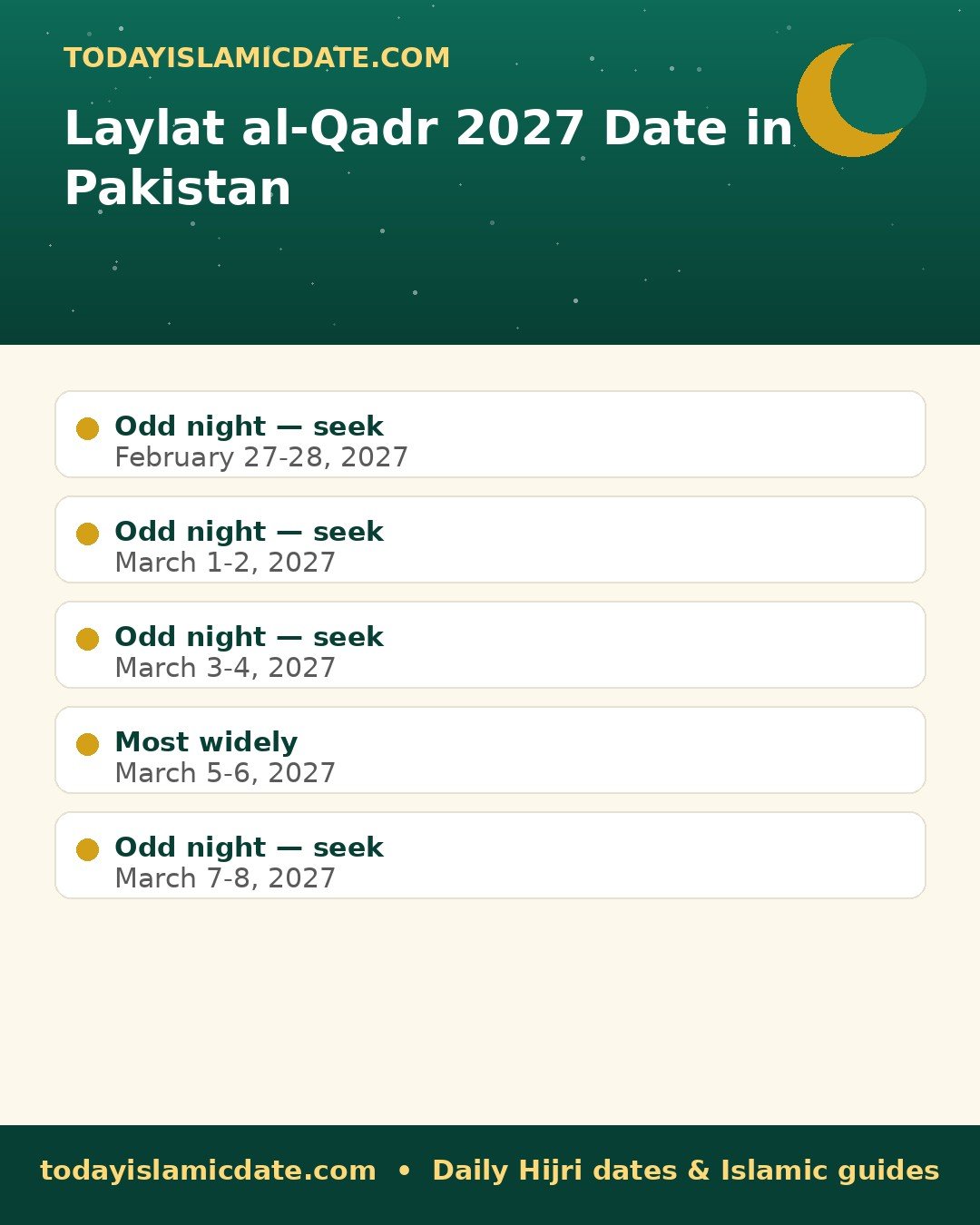
- **February 27-28, 2027:** 21st night
- **March 1-2, 2027:** 23rd night
- **March 3-4, 2027:** 25th night
- **March 5-6, 2027:** 27th night
- **March 7-8, 2027:** 29th night
- **March 10, 2027:** —
Key Takeaways
- Laylat al-Qadr 2027 (27 Ramadan 1448) is expected on the night of 5-6 March 2027 in Pakistan.
- The exact night is hidden — seek it in all of the last ten nights, especially the odd nights.
- The Quran says Laylat al-Qadr is better than a thousand months (Surah Al-Qadr, 97:3).
- Ramadan 1448 in Pakistan is expected to begin on 8 February 2027 (Saudi Arabia may start 7 February).
What Is Laylat al-Qadr?
Laylat al-Qadr is the night on which the Quran was first revealed to the Prophet Muhammad (PBUH). Allah describes it in Surah Al-Qadr: ‘Indeed, We sent the Quran down during the Night of Decree. And what can make you know what is the Night of Decree? The Night of Decree is better than a thousand months’ (97:1-3). Worship on this single night carries more reward than worship across more than 83 years.
The exact night was hidden by Allah’s wisdom, so that Muslims would strive throughout the last ten nights of Ramadan rather than worshipping on one night only. The Prophet (PBUH) said: ‘Seek Laylat al-Qadr in the odd nights of the last ten days of Ramadan’ (Sahih Bukhari).
Laylat al-Qadr 2027 Date in Pakistan
In Pakistan, the 27th night of Ramadan is the most widely observed candidate for Laylat al-Qadr. In 2027, Ramadan 1448 is expected to begin on Monday, 8 February 2027, which makes 27 Ramadan fall on Saturday, 6 March 2027 — so the night begins after sunset on Friday, 5 March. This is an expected date, confirmed only after the Ruet-e-Hilal moon sighting.
Note that Pakistan’s Ramadan may begin one day later than Saudi Arabia‘s — Saudi Arabia is expected to start Ramadan on 7 February 2027. If you follow the Pakistani announcement, the 27th night is 5-6 March; if you follow the Saudi calendar, it would be a night earlier. Always follow your country’s official announcement.
- 21 Ramadan 1448 — night of 27-28 February 2027
- 23 Ramadan 1448 — night of 1-2 March 2027
- 25 Ramadan 1448 — night of 3-4 March 2027
- 27 Ramadan 1448 — night of 5-6 March 2027
- 29 Ramadan 1448 — night of 7-8 March 2027
How to Seek Laylat al-Qadr
The best way to seek Laylat al-Qadr is to worship on all of the last ten nights. In Pakistan, mosques hold Taraweeh and Tahajjud prayers, and many people observe Itikaf (seclusion in the mosque) during the last ten days. Even if you cannot attend the mosque every night, pray at home, recite the Quran, and make sincere dua.
The Prophet (PBUH) taught Aisha (RA) a special dua for this night: ‘Allahumma innaka afuwwun tuhibbul afwa fa’fu anni’ — ‘O Allah, You are Pardoning and You love pardon, so pardon me’ (Tirmidhi). Repeat this dua often in the last ten nights.
Signs and Virtues of the Night
Scholars mention that Laylat al-Qadr is a peaceful night — the sun rises the next morning without strong rays, and the night feels calm and serene. But these signs are only recognised after the night has passed, so they cannot be used to identify it in advance. The practical approach is simple: treat every one of the last ten nights as if it could be Laylat al-Qadr.
The reward is immense. A single night of sincere worship can outweigh a lifetime of ordinary worship. That is why Muslims in Pakistan and worldwide dedicate the last ten nights of Ramadan to extra prayer, charity, and Quran recitation.
The Fiqh of Fasting: Rules Every Muslim Should Know
Fasting (sawm) is one of the five pillars, obligatory on every adult, sane, resident Muslim who is physically able (Quran 2:183–185). The fast runs from true dawn (Fajr) to sunset (Maghrib) — abstaining from food, drink, and marital relations, with the intention (niyyah) made before dawn each night.
**What breaks the fast:** eating or drinking intentionally; intentional vomiting; menstrual or postnatal bleeding beginning during the day. **What does NOT break the fast** (majority view): forgetful eating or drinking (‘Allah has fed him and given him drink’ — Sahih al-Bukhari); brushing teeth without swallowing; tasting food without swallowing (for a cook, then spitting); eye drops and kohl; injections that are not nutritional (many contemporary scholars); blood tests and cupping (per the stronger view). When in doubt, ask a qualified scholar — and remember the principle: certainty is not removed by doubt.
**Exemptions:** the sick, travelers, menstruating/postnatal women, pregnant or nursing women (if fasting harms them or the child), and the elderly who cannot fast. Missed fasts are made up later (qada) — except those with chronic inability, who pay **fidya**: feeding one poor person per missed fast (Quran 2:184), roughly the cost of a meal. **Kaffara** (expiation) applies to deliberately breaking a Ramadan fast without valid excuse: fasting 60 consecutive days, or if unable, feeding 60 poor people — in that order (Sahih al-Bukhari, Sahih Muslim).
The inner fiqh matters most: the Prophet (PBUH) said, ‘Whoever does not give up false speech and evil deeds, Allah has no need of his leaving food and drink’ (Sahih al-Bukhari). A fast of the stomach without a fast of the tongue, eyes, and heart is an empty shell. Guard all of them — that is the fast Allah loves.
Taraweeh, Itikaf and the Last Ten Nights
Ramadan’s nights are as precious as its days. **Taraweeh** — the night prayer of Ramadan — is a Sunnah the Prophet (PBUH) prayed and encouraged: ‘Whoever prays at night in Ramadan out of faith and hope for reward, his previous sins are forgiven’ (Sahih al-Bukhari, Sahih Muslim). He prayed it in congregation a few nights, then stopped — fearing it would become obligatory. Caliph Umar (RA) later gathered the companions behind one imam, establishing the congregational Taraweeh we know.
**How many rakats?** The well-known difference: 8 rakats (+3 witr) is the practice attributed to the Prophet’s (PBUH) own prayer (Sahih al-Bukhari — Aisha (RA) reported he never exceeded 11 in Ramadan or otherwise), while 20 rakats (+3 witr) was established under Umar (RA) and became the practice of the Haramain and most of the ummah. Both are valid Sunnah positions held by great scholars — pray whichever your mosque follows, and never let the number divide the congregation. What matters is presence of heart, not just count.
**Itikaf** — secluding oneself in the mosque for worship — was practiced by the Prophet (PBUH) every Ramadan, in the last ten days (Sahih al-Bukhari), and he never abandoned it. The one intending itikaf enters before Maghrib of the 21st night and stays until Eid morning, devoting the time to prayer, Quran, dua, and dhikr. If full itikaf isn’t possible, spend even one night or the odd nights in the mosque. **The last ten nights** are the month’s crown: the Prophet (PBUH) would ‘tighten his waist-wrapper, spend the nights in worship, and wake his family’ (Sahih al-Bukhari). Plan now: take leave if possible, prepare a dua list, give charity each night, and seek Laylat al-Qadr — better than a thousand months.
Ramadan Around the World: Beautiful Traditions
One month, 1.8 billion people, countless beautiful customs — Ramadan’s unity shines through its diversity. In **Egypt**, the *fanous* (lantern) lights up streets and homes, a centuries-old symbol of the holy month; children parade with lanterns singing traditional songs. In **Turkey**, mosques string *mahya* — illuminated messages between minarets — while drummers still walk pre-dawn streets waking people for suhoor, an Ottoman tradition alive today.
In **South Asia**, *Chaand Raat* (the night of the Shawwal moon) turns markets into festivals; *Rooh Afza* and pakoras define iftar tables from Karachi to Dhaka. In the **Gulf**, the *midfa al-iftar* (iftar cannon) fires at sunset — a tradition dating to Ottoman Egypt — while families gather for lavish *majlis* iftars. In **Morocco**, *harira* soup and *chebakia* sweets break the fast; in **Indonesia**, the *bedug* drum echoes before Maghrib and *kolak* sweetens iftar. In **Bosnia**, the *top* cannon fires from the hills above Sarajevo.
These customs are cultural expressions, not religious requirements — and that is their beauty. Islam gives the framework (fasting, prayer, charity); cultures fill it with color. Enjoy your community’s traditions, respect others’, and remember the core is identical worldwide: from Fajr to Maghrib, the ummah fasts as one.
Suhoor and Iftar Nutrition: Eating for Healthy Fasting
Fasting is worship, but the body is its vehicle — fuel it wisely. **Suhoor** is the most important meal: the Prophet (PBUH) said, ‘Take suhoor, for there is blessing in suhoor’ (Sahih al-Bukhari, Sahih Muslim). Eat **complex carbohydrates** (oats, whole grains, brown rice) for slow energy, **protein** (eggs, yogurt, lentils) for satiety, **fiber** (fruits, vegetables) for digestion, and **healthy fats** (nuts, olive oil). Avoid excess salt and caffeine — they dehydrate. Drink 2–3 glasses of water, but don’t chug excessively at once.
**Iftar:** break with dates and water, following the Sunnah (Sunan al-Tirmidhi) — dates restore blood sugar gently. Pray Maghrib, then eat a balanced meal: soup, lean protein, vegetables, moderate carbs. **Avoid** the twin traps: deep-fried feasts that cause lethargy, and sugary drinks that spike and crash. Eat to 80% fullness — overeating ruins Taraweeh and defeats fasting’s discipline.
**Hydration strategy:** between iftar and suhoor, sip water steadily (8–10 glasses total); include hydrating foods (cucumber, watermelon, oranges, soups). Limit coffee — it’s diuretic. **Exercise:** light walking after Taraweeh or before iftar is ideal; intense workouts are better after iftar. **Sleep:** shift schedules pragmatically — a post-Fajr nap and early night preserve energy for worship. Those with medical conditions (diabetes, hypertension, pregnancy) must consult doctors *before* Ramadan — Islam exempts the genuinely unable; protecting health is itself obedience.
Missed Fasts: Qada, Fidya and Kaffara Explained
Not every fast is kept — illness, travel, menstruation, and other excuses intervene. Islam’s system for missed fasts is merciful and precise. **Qada (make-up):** any obligatory Ramadan fast missed for a valid excuse is fasted later, one day for one day, before the next Ramadan ideally (Quran 2:184–185). Make the intention at night; the make-up fast follows normal fasting rules.
**Fidya (compensation):** for those who *cannot* make up fasts — the chronically ill, the very elderly — each missed fast is compensated by feeding one poor person (Quran 2:184), approximately the cost of a full meal (often calculated as ~$10–15 or local equivalent; check your mosque’s rate). Fidya may be given as food or its monetary value to trusted charities. Note: fidya is for inability, not convenience — the able must fast or make up.
**Kaffara (expiation):** for *deliberately* breaking a Ramadan fast without valid excuse (eating, drinking, or intercourse during the day) — in order: (1) free a slave (not applicable today), (2) fast **60 consecutive days**, or (3) if genuinely unable, feed **60 poor people** (Sahih al-Bukhari, Sahih Muslim). The sequence matters — you may not jump to feeding if fasting 60 days is possible. **Common questions:** vomiting unintentionally doesn’t require qada; intentional vomiting does. Menstruation beginning mid-day breaks that day’s fast (qada required). Pregnancy/nursing: scholars differ — many require qada only, others qada plus fidya; follow your school’s position.
Zakat and Charity in Ramadan: Maximizing Reward
Ramadan is the ummah’s great season of giving — the Prophet (PBUH) was ‘the most generous of people, and most generous in Ramadan’ (Sahih al-Bukhari), when Jibreel (AS) would revise the Quran with him. Scholars note deeds multiply in Ramadan, making it the strategic time for **zakat** (many pay their annual zakat in Ramadan for multiplied reward) and **sadaqah**.
**Zakat refresher:** 2.5% of qualifying wealth (cash, savings, gold, investments, business inventory) held for one lunar year above nisab (~85g gold / 595g silver value). Calculate carefully — underpaying withholds the poor’s right; overpaying is bonus sadaqah. Pay early in Ramadan so charities deploy it during the month. **Zakat al-Fitr** (one sa’ of food per person, before Eid prayer) is separate and obligatory on every Muslim with surplus food.
**The Laylat al-Qadr strategy:** since its exact night is hidden, automate charity across all ten last nights — even small nightly donations guarantee catching the Night of Decree, when one night’s giving outweighs 83 years. **Beyond money:** feed fasting people (‘whoever feeds a fasting person earns their reward’ — Tirmidhi), volunteer at iftars, and remember the best charity is consistent (‘the most beloved deeds are most consistent’ — Bukhari, Muslim). Ramadan generosity shouldn’t end at Eid — let it seed year-round habits.
Did You Know?
- 1.8 billion: Nearly one in four humans on Earth fasts Ramadan — the largest synchronized act of worship in history.
- Fasting hours range: From ~10 hours (southern winter) to 20+ hours (northern summer) depending on latitude and season.
- First revelation: The Quran’s revelation began on a Ramadan night (2:185) — the month and the Book are inseparable.
- Zakat timing: Many Muslims pay annual zakat in Ramadan — scholars note rewards multiply in the holy month.
- 83 years: Charity on Laylat al-Qadr outweighs 83+ years of giving — automate donations across the last 10 nights.
Last Ten Nights of Ramadan 1448 — Expected Dates in Pakistan (2027)
Expected dates for the last ten nights of Ramadan 1448 in Pakistan. All dates are expected and subject to the Ruet-e-Hilal moon sighting:
| Date (Expected) | Night | Hijri Date | Note |
|---|---|---|---|
| February 27-28, 2027 | 21st night | 21 Ramadan 1448 | Odd night — seek Laylat al-Qadr |
| March 1-2, 2027 | 23rd night | 23 Ramadan 1448 | Odd night — seek Laylat al-Qadr |
| March 3-4, 2027 | 25th night | 25 Ramadan 1448 | Odd night — seek Laylat al-Qadr |
| March 5-6, 2027 | 27th night | 27 Ramadan 1448 | Most widely observed — Laylat al-Qadr |
| March 7-8, 2027 | 29th night | 29 Ramadan 1448 | Odd night — seek Laylat al-Qadr |
| March 10, 2027 | — | 1 Shawwal 1448 | Eid ul-Fitr (expected) |
Key Terms Glossary
- **Sawm** — fasting — abstaining from food, drink, and marital relations from Fajr to Maghrib.
- **Suhoor** — the pre-dawn meal; eating it carries blessing (Sahih al-Bukhari).
- **Iftar** — the sunset meal breaking the fast — hastening it is Sunnah.
- **Taraweeh** — the Ramadan night prayer, prayed in congregation after Isha.
- **Itikaf** — seclusion in the mosque for worship, Sunnah in Ramadan’s last ten days.
- **Qada** — making up a missed obligatory fast on another day.
- **Fidya** — feeding one poor person per fast missed due to chronic inability.
- **Kaffara** — expiation for deliberately breaking a fast: 60 consecutive fasts or feeding 60 poor.
Common Mistakes to Avoid
- **Skipping suhoor:** the Prophet (PBUH) said suhoor has blessing (barakah) — even dates and water (Sahih al-Bukhari). Never skip it.
- **Overeating at iftar:** stuffing yourself defeats fasting’s purpose and ruins Taraweeh — break light, pray Maghrib, then eat moderately.
- **Wasting the nights:** Ramadan’s nights are for qiyam and dua, not entertainment marathons — especially the last ten.
- **Backbiting while fasting:** ‘Allah has no need of his leaving food and drink’ (Bukhari) — guard the tongue or the fast is hollow.
- **Delaying missed fasts:** make up (qada) missed Ramadan fasts before the next Ramadan arrives — don’t let them pile up.
Frequently Asked Questions
When is Laylat al-Qadr 2027 in Pakistan?
The 27th night of Ramadan 1448 is expected on the night of Friday, 5 March to Saturday, 6 March 2027 in Pakistan, subject to the moon sighting. The exact night is hidden, so seek it in all of the last ten nights.
Why is the 27th night the most observed?
Many narrations and the practice of the Companions point to the 27th night, and the majority of Muslims in Pakistan observe it as Laylat al-Qadr — but the Prophet (PBUH) instructed us to seek it in all the odd nights of the last ten days.
What dua should I read on Laylat al-Qadr?
The Prophet (PBUH) taught: ‘Allahumma innaka afuwwun tuhibbul afwa fa’fu anni’ — ‘O Allah, You are Pardoning and You love pardon, so pardon me’ (Tirmidhi).
Is Laylat al-Qadr on the same night in every country?
Not necessarily. Countries that start Ramadan on different days will have the 27th night on different Gregorian dates. Pakistan’s date depends on its own moon sighting.
What if I miss the 27th night?
Worship on any of the last ten nights counts. The night is hidden precisely so Muslims strive throughout the last ten nights — any night could be the one.
Does brushing teeth break the fast?
No — brushing without swallowing water or toothpaste does not break the fast (majority view). Use a miswak or brush carefully, rinse lightly, and spit thoroughly. The Prophet (PBUH) used the miswak while fasting.
Can I get an injection while fasting?
Non-nutritional injections (vaccines, insulin per many scholars, local anesthesia) do not break the fast according to many contemporary scholars, as they are not food or drink. Nutritional IV drips do break it. When in doubt, consult a scholar and your doctor.
What if I eat forgetfully while fasting?
Your fast is valid — continue fasting. The Prophet (PBUH) said: ‘If one forgets and eats or drinks, let him complete his fast, for Allah has fed him and given him drink’ (Sahih al-Bukhari, Sahih Muslim).
How do I make up missed Ramadan fasts?
Fast one day for each missed day before the next Ramadan (qada), with intention the night before. If you cannot fast due to chronic illness or old age, pay fidya — feeding one poor person per missed day (Quran 2:184).
Is it better to fast 8 or 20 Taraweeh rakats?
Both are valid Sunnah positions: 8 (+3 witr) follows the Prophet’s (PBUH) personal practice; 20 (+3) was established under Umar (RA). Pray with your congregation — unity outweighs the number.
Can I fast while pregnant or breastfeeding?
If fasting harms you or the child, you are exempt (the Prophet (PBUH) lifted it from them — Sunan al-Nasai). Consult your doctor; make up fasts later or pay fidya per your school’s guidance.
Does vomiting break the fast?
Unintentional vomiting does not break the fast; deliberately inducing vomiting does (Sunan al-Tirmidhi) and requires making up that day.
When should I pay Zakat al-Fitr?
Before the Eid prayer — it purifies the fast (Sunan Abu Dawud). One sa’ (~2.5–3 kg) of staple food per person, including children; most mosques collect and distribute it.
Sources & How This Article Was Researched
Every guide on TodayIslamicDate.com is researched from primary Islamic sources — the Holy Quran and the authentic hadith collections — combined with astronomical data for date projections.
Our editorial process: (1) gather evidence from the Quran and hadith, (2) cross-check historical dates across multiple references, (3) compute expected Gregorian dates from lunar astronomy, (4) review for accuracy and balanced presentation of scholarly differences. Expected dates are always projections — your country’s official moon-sighting announcement is the final authority.
- This article references the following primary Islamic sources:
- – Holy Quran
- – Sahih al-Bukhari
- – Sunan al-Tirmidhi
- – Astronomical projections follow standard lunar visibility criteria; actual month starts depend on the crescent sighting in each country.
- – Quran translations follow widely published English renderings (e.g., Saheeh International). Hadith references can be verified on established hadith databases.
Conclusion
Laylat al-Qadr 2027 is expected on the night of 5-6 March 2027 in Pakistan — a night better than a thousand months. Do not limit your worship to one night; seek it in all of the last ten nights of Ramadan with prayer, Quran, and dua.
Check today’s Islamic date on our site to follow Ramadan 1448 day by day, and confirm the final dates with the Ruet-e-Hilal Committee’s official announcement.
Check Today’s Islamic Date by Country
Daily updated Hijri dates for Muslims around the world: