
Iqbal Day — 9 November: Allama Iqbal’s Life, Poetry and Message
Every year on 9 November, Pakistan celebrates Iqbal Day — the birthday of Allama Muhammad Iqbal, the poet-philosopher whose ideas inspired the creation of Pakistan. Born on 9 November 1877 in Sialkot, Iqbal is remembered as Musawwir-e-Pakistan (the Architect of Pakistan), Shair-e-Mashriq (the Poet of the East), and Mufakkir-e-Pakistan (the Thinker of Pakistan).
In 2026, Iqbal Day falls on Monday, 9 November — which is 28 Jumada al-Awwal 1448 AH in the Hijri calendar. The day is a public holiday in Pakistan, marked by ceremonies at Iqbal’s mausoleum in Lahore, seminars, school programmes, and special broadcasts. This guide covers who Iqbal was, why his message still matters, and how Pakistan honours him every year.
Islamic history is often reduced to dates and battles — but it’s really the story of how Allah’s guidance transformed the world through human hearts. These events carry lessons for leadership, mercy, unity, and resilience that speak directly to today. This guide presents the history with sources, context, and the lessons we’re meant to carry forward.
Quick Answer
Iqbal Day is celebrated every year on 9 November, the birthday of Allama Muhammad Iqbal (born 1877 in Sialkot). Iqbal’s 1930 Allahabad Address first proposed a separate Muslim state in north-west India — the idea that led to Pakistan.
Key Facts at a Glance
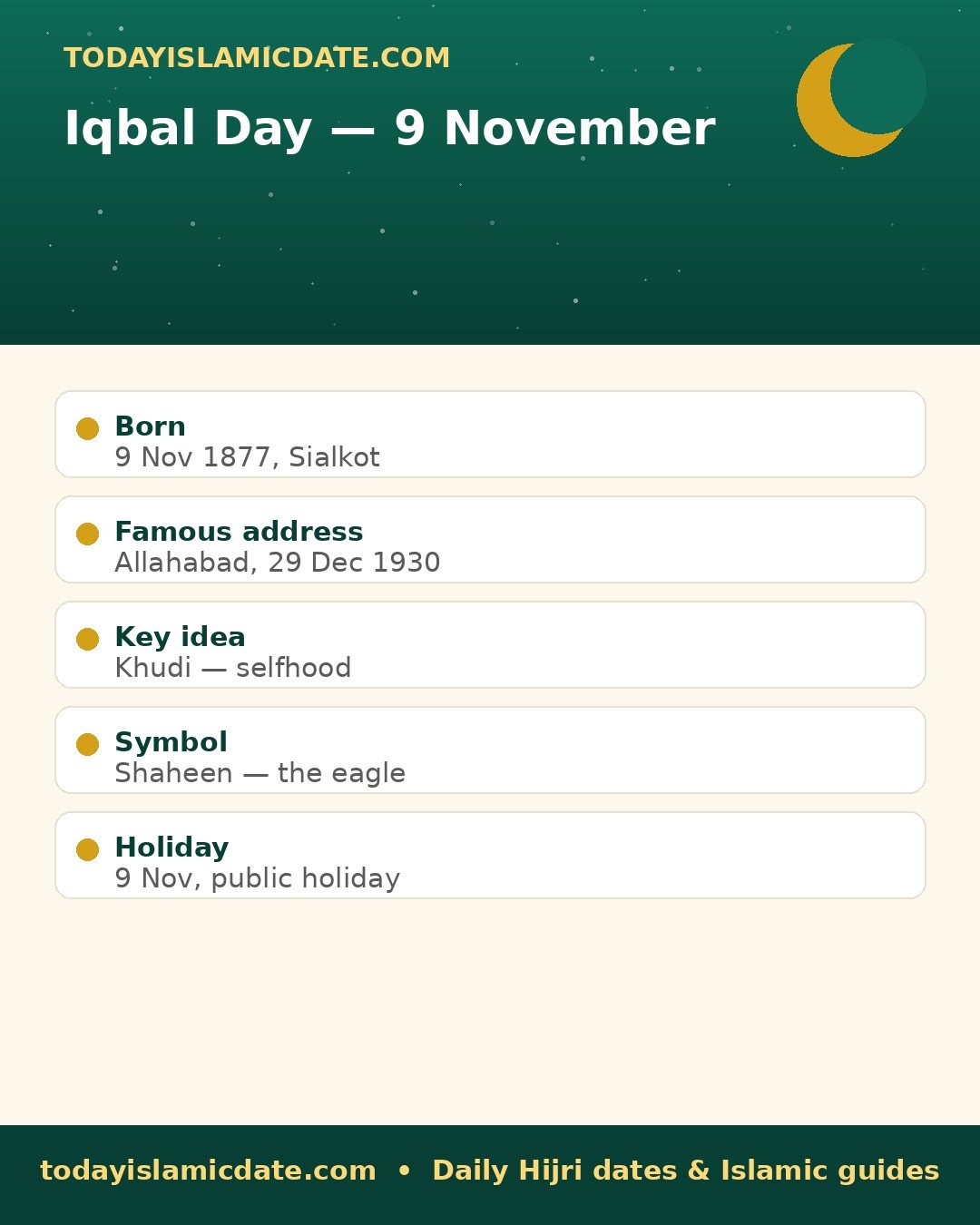
- **9 November 1877:** Born in Sialkot, Punjab
- **1905 – 1908:** Studies in England and Germany; PhD from Munich (1907)
- **1915:** Asrar-e-Khudi (Secrets of the Self) published
- **1922:** Knighted — becomes Sir Muhammad Iqbal
- **1924:** Bang-e-Dara, his first Urdu poetry collection
- **29 December 1930:** Allahabad Address — proposes a separate Muslim state
Key Takeaways
- Iqbal Day is celebrated every year on 9 November, the birthday of Allama Muhammad Iqbal (born 1877 in Sialkot).
- Iqbal’s 1930 Allahabad Address first proposed a separate Muslim state in north-west India — the idea that led to Pakistan.
- His message of Khudi (selfhood) and the Shaheen (eagle) still inspires Pakistan’s youth.
- 9 November is a public holiday in Pakistan, marked by ceremonies at his mausoleum in Lahore.
Who Was Allama Iqbal?
Muhammad Iqbal was born on 9 November 1877 in Sialkot, in a Kashmiri family. He studied at Government College Lahore, then went to England, where he studied at Trinity College, Cambridge, and qualified as a barrister. In 1907 he earned a PhD in philosophy from the University of Munich in Germany, with a thesis on the development of metaphysics in Persia.
After returning to India, Iqbal practised law and taught philosophy, but his real fame came from his poetry. He wrote in both Urdu and Persian, and his poetry carried a powerful message: Muslims must wake up, trust themselves, and rebuild their strength. He died on 21 April 1938 in Lahore, nine years before Pakistan was created, and is buried in the Mazar-e-Iqbal next to the Badshahi Mosque.
The Allahabad Address and the Idea of Pakistan
Iqbal’s most famous political moment came on 29 December 1930, when he addressed the All-India Muslim League session at Allahabad. In that address he proposed that the Muslim-majority provinces of north-west India — Punjab, the North-West Frontier Province, Sindh, and Baluchistan — should be combined into a separate Muslim state.
At the time, many people thought the idea was only a dream. But Muhammad Ali Jinnah took the idea forward, and on 14 August 1947 Pakistan came into being. That is why Iqbal is called Musawwir-e-Pakistan — the Architect of Pakistan. He gave the idea; Jinnah gave it political shape. Iqbal never saw the Pakistan he imagined, but his words lit the path to it.
- 29 December 1930 — Allahabad Address proposes a Muslim state in the north-west
- 1930s — Iqbal’s letters urge Jinnah to lead the Muslims of India
- 21 April 1938 — Iqbal dies in Lahore
- 14 August 1947 — Pakistan is created, fulfilling his vision
Khudi — Iqbal’s Message of Selfhood
The heart of Iqbal’s philosophy is Khudi — a word that means selfhood, self-respect, and self-reliance. In his famous Persian work Asrar-e-Khudi (Secrets of the Self, 1915), Iqbal taught that a person becomes strong by developing the self: through faith, knowledge, hard work, and courage. A weak self begs and follows; a strong self creates and leads.
His most quoted couplet carries this message: ‘Khudi ko kar buland itna ke har taqdeer se pehle, Khuda bande se khud poochhe, bata teri raza kya hai’ — raise your selfhood so high that before every decree of fate, God Himself asks you: tell me, what is your will? For Iqbal, this was not poetry alone. It was a plan for nations: a people that believes in itself cannot be kept down.
The Shaheen — Iqbal’s Eagle
Across his poetry, Iqbal returns again and again to the Shaheen — the eagle. The eagle became his symbol of the ideal young Muslim: it flies high, hunts for itself, never eats what others have left, and never builds its nest on the ground. Iqbal told the youth of the Muslim world to be like the Shaheen — fearless, self-reliant, and always aiming higher.
That is why Iqbal’s poetry is still taught in Pakistani schools and quoted in speeches. His message was not about the past. It was a call to the young: stop looking down, look up, and rise. On Iqbal Day, schoolchildren recite his poems, and his couplets are heard on television and radio across the country.
How Pakistan Celebrates Iqbal Day
Iqbal Day is a public holiday in Pakistan (restored as a public holiday in 2022). The main ceremony is held at the Mazar-e-Iqbal in Lahore, where officials lay wreaths and a ceremonial guard is mounted. People visit the mausoleum, recite Fatiha, and remember the poet who dreamed of Pakistan.
The Iqbal Academy Pakistan and universities hold seminars on his life and thought. Schools organise speech and poetry competitions, and special programmes about Iqbal run on television and radio. For many families, the day is also a quiet moment to read a few lines of Iqbal — and to ask what his message means for Pakistan today.
- Visit the Mazar-e-Iqbal in Lahore and recite Fatiha
- Read one poem — try Bang-e-Dara or Bal-e-Jibril
- Teach children the meaning of Khudi and the Shaheen
- Attend a seminar or school programme on Iqbal’s life
Iqbal’s Famous Poetry and Books
Iqbal wrote in Urdu and Persian, and his books are still read across Pakistan and the Muslim world. His most famous works are:
- Asrar-e-Khudi (Secrets of the Self, 1915) — Persian; the book where he first explained Khudi, the idea of selfhood.
- Bang-e-Dara (The Call of the Marching Bell, 1924) — his first Urdu poetry collection, including the famous poem “Shikwa” and “Jawab-e-Shikwa”.
- Payam-e-Mashriq (Message of the East, 1923) — Persian; written as a reply to Goethe’s West-Eastern Divan.
- Bal-e-Jibril (Gabriel’s Wing, 1935) — Urdu; contains many of his best-known poems.
- Zarb-e-Kalim (The Blow of Moses, 1936) — Urdu poetry on politics, faith, and the Muslim world.
- The Reconstruction of Religious Thought in Islam (1930) — his most important prose work, a series of lectures in English.
Three of his most quoted verses show his whole message in a few lines:
- “Khudi ko kar buland itna ke har taqdeer se pehle, Khuda bande se khud poochhe, bata teri raza kya hai.” — “Raise your selfhood so high that, before every decree of fate, God Himself asks you: tell Me, what is your will?”
- “Sitaron se aage jahan aur bhi hain, abhi ishq ke imtihan aur bhi hain.” — “Beyond the stars there are more worlds; the trials of love are not yet over.”
- “Tu shaheen hai, parwaz hai kaam tera, tere saamne aasman aur bhi hain.” — “You are a falcon, and flight is your work; before you there are more skies yet.”
Why Iqbal’s Message Still Matters
Iqbal’s message is not only history. In November 2026, Punjab’s School Education Department made “Iqbaliat and Ideology of Pakistan” the theme of the month for all public schools in the province, so that students learn Khudi and the Shaheen as part of their school programme. His poetry is still taught, recited, and quoted in classrooms, on television, and at the Mazar-e-Iqbal ceremony every 9 November.
For young people, his message is simple: know yourself, aim high, and do not depend on others. The Shaheen does not eat what others leave behind and does not build its nest low. That is why Iqbal Day is more than a birthday — it is a yearly reminder to rise, learn, and build.
Allama Iqbal — Life Timeline
Key dates in the life of Allama Muhammad Iqbal:
| Date | Event |
|---|---|
| 9 November 1877 | Born in Sialkot, Punjab |
| 1905 – 1908 | Studies in England and Germany; PhD from Munich (1907) |
| 1915 | Asrar-e-Khudi (Secrets of the Self) published |
| 1922 | Knighted — becomes Sir Muhammad Iqbal |
| 1924 | Bang-e-Dara, his first Urdu poetry collection |
| 29 December 1930 | Allahabad Address — proposes a separate Muslim state |
| 1935 | Bal-e-Jibril published |
| 21 April 1938 | Dies in Lahore; buried at Mazar-e-Iqbal |
| 14 August 1947 | Pakistan is created — his vision fulfilled |
| 9 November (every year) | Iqbal Day — public holiday in Pakistan |
Key Terms Glossary
- Khudi — selfhood; self-respect and self-reliance; Iqbal’s central idea.
- Shaheen — the falcon or eagle; Iqbal’s symbol of the free, self-reliant Muslim.
- Musawwir-e-Pakistan — “Architect of Pakistan”; Iqbal’s title for first proposing a separate Muslim state.
- Shair-e-Mashriq — “Poet of the East”; Iqbal’s title as the national poet of Pakistan.
- Asrar-e-Khudi — “Secrets of the Self” (1915); Iqbal’s first major work, introducing Khudi.
- Bang-e-Dara — “The Call of the Marching Bell” (1924); his first Urdu poetry collection.
- Allahabad Address — Iqbal’s 29 December 1930 presidential address proposing a separate Muslim state.
- Mazar-e-Iqbal — Iqbal’s tomb in Lahore, next to the Badshahi Mosque.
Frequently Asked Questions
When is Iqbal Day celebrated?
Iqbal Day is celebrated every year on 9 November, the birthday of Allama Muhammad Iqbal (9 November 1877). In 2026 it falls on Monday, 9 November, which is 28 Jumada al-Awwal 1448 AH.
Is Iqbal Day a public holiday in Pakistan?
Yes. Iqbal Day is a public holiday in Pakistan. The holiday was restored in 2022, so government offices, schools, and banks are closed on 9 November.
Why is Iqbal called Musawwir-e-Pakistan?
Because his 1930 Allahabad Address first gave the idea of a separate Muslim state in north-west India. That idea became Pakistan in 1947, so Iqbal is remembered as the Architect of Pakistan.
What is Khudi in Iqbal’s poetry?
Khudi means selfhood — self-respect, self-reliance, and belief in yourself. Iqbal taught that a person and a nation become strong by developing the self through faith, knowledge, and hard work.
Where is Allama Iqbal buried?
Allama Iqbal is buried at the Mazar-e-Iqbal in Lahore, next to the Badshahi Mosque. The main Iqbal Day ceremony is held there every year on 9 November.
Sources & How This Article Was Researched
Every guide on TodayIslamicDate.com is researched from primary Islamic sources — the Holy Quran and the authentic hadith collections — combined with astronomical data for date projections.
Our editorial process: (1) gather evidence from the Quran and hadith, (2) cross-check historical dates across multiple references, (3) compute expected Gregorian dates from lunar astronomy, (4) review for accuracy and balanced presentation of scholarly differences. Expected dates are always projections — your country’s official moon-sighting announcement is the final authority.
- – Astronomical projections follow standard lunar visibility criteria; actual month starts depend on the crescent sighting in each country.
- – Quran translations follow widely published English renderings (e.g., Saheeh International). Hadith references can be verified on established hadith databases.
Conclusion
Iqbal Day is more than a birthday — it is a reminder of the idea that built Pakistan. Iqbal told a nation to believe in itself, to rise like the Shaheen, and to build its own destiny. His message of Khudi is as relevant today as it was a hundred years ago.
This 9 November, read a few lines of Iqbal, share his message with your children, and check today’s Islamic date — 28 Jumada al-Awwal 1448 AH — as Pakistan remembers its greatest poet-philosopher.
Check Today’s Islamic Date by Country
Daily updated Hijri dates for Muslims around the world: