
Muharram: The Sacred First Month of the Islamic Calendar
Muharram is the first month of the Islamic (Hijri) calendar and one of the four sacred months in Islam. Its name literally means ‘forbidden’ or ‘sacred’, referring to the prohibition of warfare during this month — a rule established by Allah in the Quran (Surah At-Tawbah, 9:36).
For Muslims around the world, Muharram marks the beginning of a new Hijri year. In 2026, the month of Muharram 1448 AH began on June 16 in Saudi Arabia and the Gulf (June 17 in Pakistan, India, and Bangladesh), with the Islamic New Year falling on 1 Muharram. This guide covers everything you need to know: its meaning, the significance of Ashura, fasting virtues, and key dates.
The Hijri months are Allah’s appointed measurements of time (Quran 2:189) — yet most Muslims navigate life by the Gregorian calendar alone. Reclaiming the Islamic months reconnects worship, history, and identity: every fast, festival, and sacred night runs on this calendar. This guide gives you both the knowledge and the practical system to live by it.
Quick Answer
Muharram is the 1st Hijri month and one of the four sacred months in Islam. The 10th of Muharram (Ashura) is the most significant day — fasting on it expiates a year of sins.
Key Facts at a Glance
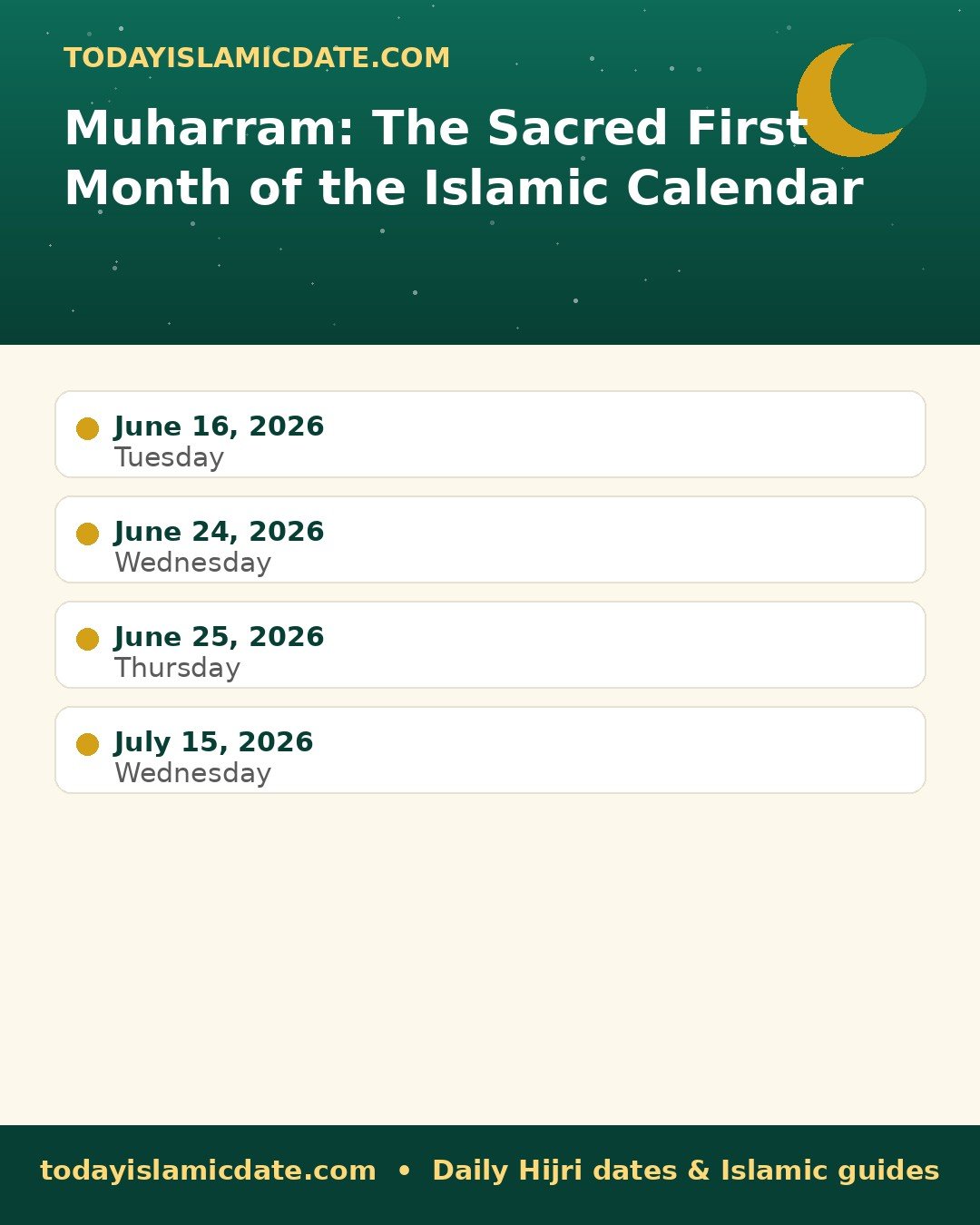
- **June 16, 2026:** Tuesday
- **June 24, 2026:** Wednesday
- **June 25, 2026:** Thursday
- **July 15, 2026:** Wednesday
Key Takeaways
- Muharram is the 1st Hijri month and one of the four sacred months in Islam.
- The 10th of Muharram (Ashura) is the most significant day — fasting on it expiates a year of sins.
- Muharram 1448 AH began June 16, 2026 in the Gulf (June 17 in South Asia).
- The Hijri calendar itself was established during Caliph Umar’s era, starting from the Hijrah.
What Does Muharram Mean?
The word ‘Muharram’ (محرم) comes from the Arabic root meaning ‘forbidden’ or ‘sacred’. Before Islam, Arab tribes already treated this month as sacred and avoided fighting in it. Islam confirmed this sanctity — the Quran declares: ‘Indeed, the number of months with Allah is twelve… of these, four are sacred’ (9:36). The four sacred months are Muharram, Rajab, Dhul Qadah, and Dhul Hijjah.
Because fighting was forbidden, Muharram became a month of peace, pilgrimage, and trade in pre-Islamic Arabia. After Islam, it retained its sacred status, and the Prophet Muhammad (PBUH) called it ‘the month of Allah’ (Shahrullah) — a unique honor no other month received.
The Significance of Ashura (10th Muharram)
The 10th day of Muharram, known as Ashura, is the most important day of this month. When the Prophet (PBUH) migrated to Madinah, he found the Jews fasting on this day in gratitude for Allah saving Musa (Moses, AS) and the Israelites from Pharaoh. He said: ‘We have more right to Musa than you,’ and fasted that day, encouraging Muslims to do the same (Sahih Bukhari, Sahih Muslim).
To distinguish from Jewish practice, the Prophet (PBUH) intended to also fast the 9th (Tasua). The hadith in Sahih Muslim states that fasting on Ashura expiates the sins of the previous year — a tremendous virtue for a single day’s fast. For Shia Muslims, Ashura also marks the martyrdom of Imam Hussain (RA) at Karbala in 61 AH, observed with mourning gatherings.
- Fast on the 9th and 10th (or 10th and 11th) of Muharram
- Increase voluntary worship and charity
- Reflect on the new Hijri year and set spiritual goals
- Learn the story of Musa (AS) and the parting of the sea
Fasting and Worship in Muharram
After Ramadan, the most virtuous fasting is in Muharram. The Prophet (PBUH) said: ‘The best fasting after Ramadan is the fasting in the month of Allah, Muharram’ (Sahih Muslim). This makes Muharram the prime month for voluntary (nafl) fasts outside Ramadan.
There is no special night prayer specific to Muharram in authentic sources, but general worship — Quran recitation, dhikr, charity, and fasting — is highly rewarded in this sacred month. Many Muslims use the Islamic New Year as a moment for self-accountability (muhasabah), reviewing the past year and planning spiritual growth.
How the Hijri Months Got Their Names
The twelve Hijri month names are far older than Islam — they come from pre-Islamic Arabia, where tribes named months after the seasons and social conditions they observed. Understanding these names opens a window into the world the Prophet Muhammad (PBUH) was born into.
**Muharram** means ‘forbidden’ or ‘sacred’ — fighting was prohibited in it. **Safar** means ’empty’ or ‘void,’ because Arab houses stood empty as people left in search of food or went to war after Muharram’s truce. **Rabi al-Awwal** and **Rabi al-Thani** mean ‘the first spring’ and ‘the second spring,’ marking the season of pasture and rain. **Jumada al-Ula** and **Jumada al-Akhirah** mean ‘the first freeze’ and ‘the last freeze’ — water would freeze in the desert winter.
**Rajab** comes from a root meaning ‘to respect’ or ‘honor’ — it was a truce month even before Islam, honored by all tribes. **Sha’ban** means ‘to scatter’ or ‘distribute,’ as tribes dispersed in search of water. **Ramadan** derives from *ramada*, ‘scorching heat’ — fasting in the desert summer tested endurance. **Shawwal** means ‘to raise,’ referring to she-camels raising their tails. **Dhul Qa’dah** means ‘the month of sitting’ (*qa’ada*, to sit) — tribes sat down their weapons in this truce month before Hajj. **Dhul Hijjah** is simply ‘the month of pilgrimage.’
When the Islamic calendar was formalized under Caliph Umar (RA), these ancient names were kept — a beautiful continuity. The months no longer align with their original seasons (because the pure lunar year drifts about 11 days annually against the solar year), but the names preserve the memory of Arabia’s seasons 1,400 years ago. Today, Ramadan can fall in winter and Rabi al-Awwal in summer — yet the names remain, connecting every Muslim to the desert heritage of the calendar.
The Four Sacred Months: Rules and Wisdom
The Quran declares: ‘Indeed, the number of months with Allah is twelve [lunar] months in the register of Allah from the day He created the heavens and the earth; of these, four are sacred’ (9:36). The Prophet (PBUH) identified them in his Farewell Sermon: ‘The year is twelve months, of which four are sacred: three consecutive — Dhul Qa’dah, Dhul Hijjah, and Muharram — and Rajab of Mudar, which is between Jumada and Sha’ban’ (Sahih al-Bukhari, Sahih Muslim).
What does ‘sacred’ mean in practice? First, **warfare was forbidden** in these months — a divine ceasefire that protected pilgrims traveling to Hajj (Dhul Qa’dah for the journey, Dhul Hijjah for the rites, Muharram for the return) and honored Rajab’s ancient sanctity. Second, **sins carry greater weight** — the Quran warns ‘so do not wrong yourselves therein’ (9:36), meaning injustice and disobedience in sacred months are graver. Third, **good deeds are magnified** — scholars note that worship in sacred months earns multiplied reward, just as sins are multiplied in seriousness.
The wisdom is profound: Islam built peace into the calendar itself. Three consecutive sacred months created a guaranteed annual season of safety for travel, trade, and pilgrimage across Arabia’s dangerous deserts. Rajab, standing alone mid-year, gave tribes a mid-year breather. For us today, the sacred months are a spiritual alarm clock — four times a year, Allah commands extra mindfulness. Use them to audit your life: increase fasting, charity, and Quran, and guard your tongue and dealings with special care.
Living by the Hijri Months: A Practical Guide
Most Muslims know the Gregorian date instantly but hesitate on the Hijri one. Reclaiming the Islamic calendar in daily life is simpler than it seems — and deeply rewarding, because every act of worship in Islam runs on Hijri time.
**Step 1: Learn the order.** Memorize the twelve months with a simple rhyme or song — teach it to your children the way you teach the ABCs. **Step 2: Track the current month.** Check our homepage daily, enable the Hijri calendar on your phone (iPhone: Settings → Calendar → Alternate Calendars; Android: Google Calendar → Alternate calendar), and note the date each morning. **Step 3: Anchor worship to months.** Plan white-days fasting (13th–15th) each month, increase devotion in sacred months, and prepare two months ahead for Ramadan (Rajab plants, Sha’ban waters, Ramadan harvests). **Step 4: Mark the milestones.** Put Ashura, Laylat al-Qadr’s window, Arafat, and the Eids on your family calendar at the year’s start.
Parents: make the Hijri calendar visible at home — a wall calendar, a daily announcement at dinner (‘Today is 14 Sha’ban — white days start tomorrow!’). Children who grow up hearing Hijri dates develop an instinctive connection to Islamic time. Communities: mosques can announce the Hijri date before Jumu’ah khutbah, reviving a Sunnah of time-consciousness. The Gregorian calendar organizes your work; let the Hijri calendar organize your soul.
Month-by-Month Worship Planner for the Whole Hijri Year
Imagine the Hijri year as a spiritual training calendar — each month with its own focus. **Muharram:** begin with Ashura fasting (9th–10th) and a year of intention-setting. **Safar:** no superstition (the Prophet (PBUH) negated bad omens — Sahih al-Bukhari) — just steady worship. **Rabi al-Awwal:** study the seerah deeply; increase salawat on the Prophet (PBUH). **Rabi al-Thani:** consolidate habits; review your year’s goals.
**Jumada al-Ula & al-Akhirah:** quiet months — perfect for building Quran memorization and the white-days fasts. **Rajab:** the first sacred month of the year’s second half — plant the seeds: increase istighfar and voluntary fasts. **Sha’ban:** the Prophet (PBUH) fasted most of it (Sahih al-Bukhari) — water the seeds; settle missed fasts and debts before Ramadan.
**Ramadan:** the harvest — full devotion: fasting, qiyam, Quran, charity, itikaf. **Shawwal:** six fasts (like a year of fasting — Sahih Muslim) and Eid joy. **Dhul Qa’dah:** sacred rest — prepare for Hajj season spiritually even if not going. **Dhul Hijjah:** the first ten days — ‘the best days’ (Sahih al-Bukhari) — fasting Arafat, qurbani, Eid. Print this planner, pin it up, and let the Hijri year disciple your soul month by month.
The Islamic New Year: Meaning and How to Observe It
1 Muharram opens the Hijri year — but unlike January 1st, it arrives quietly, without fireworks. There is no prescribed worship specific to the New Year night; the Sunnah’s ‘celebration’ is reflection and resolve. The companions marked time’s passage with *muhasaba* — self-accounting — a practice Umar (RA) captured: ‘Take account of yourselves before you are taken to account.’
A meaningful Islamic New Year routine: **review** the past year — which months did you honor? Which worship slipped? **Repent** sincerely for shortcomings; Allah loves the oft-returning. **Set intentions** — three spiritual goals (e.g., finish the Quran, never miss Fajr, monthly charity) and three character goals (control anger, keep ties, speak truth). **Learn** one new thing about the Hijri calendar each year — this very site is built for that.
Some cultures have New Year customs — special foods, family gatherings — which are permissible as cultural expression, not religious ritual. Keep the focus inward: the Hijri New Year is not about celebration but *orientation* — turning the compass of the heart back toward Allah as another year of the calendar He ordained begins.
Fasting the White Days: The Monthly Sunnah
Beyond Ramadan, the Prophet (PBUH) fasted regularly each month — most famously the **White Days** (*ayyam al-beed*): the 13th, 14th, and 15th of every Hijri month, when the moon is fullest and brightest. He said: ‘Fasting three days of each month is like fasting the whole year’ (Sahih al-Bukhari, Sahih Muslim) — because each good deed is multiplied tenfold, three days equal thirty.
The White Days are the heartbeat of the Hijri months — a monthly mini-Ramadan keeping the soul in training year-round. **Practical guide:** mark the 13th–15th on your calendar each month (our homepage shows the current Hijri date). Fast all three if able; if not, fast any three days — the Prophet (PBUH) also advised fasting *any* three days monthly (Sahih Muslim). Combine with Monday/Thursday Sunnah fasts for maximum rhythm: some weeks you’ll fast 3–4 days, building remarkable consistency.
**Why it transforms you:** monthly fasting maintains the taqwa Ramadan builds, preventing the post-Ramadan crash. It disciplines appetite, sharpens empathy for the hungry, and multiplies reward enormously — twelve months of White Days equals the reward of *twelve years* of fasting. Teach children with a sticker chart; compete with family; make the full moon a reminder. The Hijri months aren’t just dates to track — they’re invitations, renewed monthly, to draw closer to Allah.
Did You Know?
- Oldest names: The Hijri month names pre-date Islam by centuries, coming from pre-Islamic Arabia’s seasonal calendar.
- Sacred count: 4 of the 12 months are sacred — one-third of the entire Islamic year carries special sanctity.
- Drift: Because of the 11-day annual drift, Ramadan will be a winter month again in the 2030s for the Northern Hemisphere.
- White Days: Fasting the 13th–15th of each month equals a year of fasting in reward (Bukhari, Muslim).
- Quranic months: The Quran names only Ramadan among months — the rest come through Sunnah and Arab tradition.
Muharram 1448 AH: Key Dates (2026)
Expected dates for Muharram 1448 based on astronomical calculations. Actual dates depend on moon sighting in your country:
| Date (Expected) | Day | Hijri Date | Event |
|---|---|---|---|
| June 16, 2026 | Tuesday | 1 Muharram 1448 | Islamic New Year — start of 1448 AH |
| June 24, 2026 | Wednesday | 9 Muharram 1448 | Tasua — recommended fast |
| June 25, 2026 | Thursday | 10 Muharram 1448 | Ashura — fasting expiates a year’s sins |
| July 15, 2026 | Wednesday | 1 Safar 1448 | End of Muharram (expected) |
Key Terms Glossary
- **Hilal** — the waxing crescent moon whose sighting begins a new Islamic month.
- **Rukyah** — the physical sighting of the crescent — the classical basis for starting months.
- **Muharram** — the first, sacred month of the Hijri year; warfare was forbidden in it.
- **Ash-hur al-hurum** — the four sacred months: Dhul Qa’dah, Dhul Hijjah, Muharram, Rajab.
- **Nasi’** — the pre-Islamic practice of intercalating months, abolished by the Quran (9:36–37).
- **Umm al-Qura** — Saudi Arabia’s official calculated lunar calendar for civil use.
- **29th evening** — the night the crescent is sought; the month’s length (29/30 days) is decided then.
- **1447 AH** — ‘Anno Hegirae’ — years counted from the Hijra (622 CE); the current Hijri era.
Common Mistakes to Avoid
- **Assuming every Hijri month has 30 days:** months are 29 or 30 days, decided by the crescent — never assume.
- **Ignoring the moon sighting:** the month begins with the hilal, not the printed calendar — always confirm, especially for Ramadan and Eid.
- **Thinking sacred months ban all travel or work:** only warfare was forbidden; normal life, trade, and even Hajj-preparation continue.
- **Mixing up Rabi al-Awwal and Rabi al-Thani:** remember — Awwal means first, Thani means second.
- **Forgetting the 11-day drift:** Islamic dates move ~11 days earlier each Gregorian year — last year’s Ramadan dates don’t apply this year.
Frequently Asked Questions
When does Muharram 2026 start?
Muharram 1448 AH began on June 16, 2026 in the Gulf (June 17 in South Asia). Some countries may start a day earlier or later.
What is Ashura and why is it important?
Ashura is the 10th of Muharram. It commemorates Allah saving Musa (AS) from Pharaoh. Fasting on this day expiates the sins of the previous year (Sahih Muslim).
Is it Sunnah to fast the whole month of Muharram?
Fasting the entire month is not required, but voluntary fasting in Muharram is highly virtuous — the Prophet (PBUH) called it the best fasting after Ramadan.
Why is Muharram called a sacred month?
Allah designated four months as sacred in the Quran (9:36), forbidding warfare in them. Muharram is one of these four, along with Rajab, Dhul Qadah, and Dhul Hijjah.
What happened on Ashura in Islamic history?
Key events include Allah saving Musa (AS) from Pharaoh, and — in 61 AH — the martyrdom of Imam Hussain (RA), the Prophet’s grandson, at Karbala.
Why do Hijri months have 29 or 30 days?
Because Islamic months follow the moon’s cycle (~29.5 days). On the 29th evening, the crescent is sighted: if seen, the new month begins; if not, the month completes 30 days (Sahih al-Bukhari, Sahih Muslim). This keeps the calendar tied to the actual moon, not calculation alone.
Which is the first month of the Islamic calendar?
Muharram — the sacred month that opens the Hijri year. The Islamic New Year (1 Muharram) is a public holiday in many Muslim countries. In 2026, 1 Muharram 1448 is expected around June 16.
What are the four sacred months?
Dhul Qa’dah, Dhul Hijjah, Muharram, and Rajab (Quran 9:36; Sahih al-Bukhari). Warfare was forbidden in them, sins are graver, and good deeds are magnified. Three are consecutive (covering Hajj season); Rajab stands alone.
Why do Islamic dates change every year?
The Hijri year (~354 days) is about 11 days shorter than the Gregorian year (~365 days). So every Islamic date arrives ~11 days earlier each Gregorian year, cycling through all seasons roughly every 33 years.
Is the Islamic New Year a religious holiday?
1 Muharram is a public holiday in many Muslim countries, but there is no prescribed worship for it in the Sunnah. Muslims mark it with reflection, repentance, and renewed intentions rather than ritual celebration.
Why does Muharram start the year if the Hijra was in Rabi al-Awwal?
The companions chose Muharram because the Hijra’s planning and departure preparations fell in Muharram, and it was already a sacred month — Uthman (RA) proposed it and the council agreed.
Do Hijri months have fixed seasons?
No — the 11-day annual drift means months cycle through all seasons over ~33 years. Month names (like Ramadan, ‘scorching’) preserve ancient Arabian seasons, not current ones.
How can I memorize the Hijri months?
Learn them in rhythmic groups of three or four, teach them to children as a song, and use them daily — checking the date each morning builds memory within weeks. Our month guides include memory aids.
Sources & How This Article Was Researched
Every guide on TodayIslamicDate.com is researched from primary Islamic sources — the Holy Quran and the authentic hadith collections — combined with astronomical data for date projections.
Our editorial process: (1) gather evidence from the Quran and hadith, (2) cross-check historical dates across multiple references, (3) compute expected Gregorian dates from lunar astronomy, (4) review for accuracy and balanced presentation of scholarly differences. Expected dates are always projections — your country’s official moon-sighting announcement is the final authority.
- This article references the following primary Islamic sources:
- – Sahih al-Bukhari
- – Sahih Muslim
- – Astronomical projections follow standard lunar visibility criteria; actual month starts depend on the crescent sighting in each country.
- – Quran translations follow widely published English renderings (e.g., Saheeh International). Hadith references can be verified on established hadith databases.
Conclusion
Muharram opens the Islamic year with sanctity and reflection. Whether you fast on Ashura, increase your worship, or simply use the new Hijri year to reset your spiritual goals, this sacred month offers immense reward.
Check today’s Islamic date on our country pages to follow Muharram 1448 day by day, and explore our guides to the other sacred months — Rajab, Dhul Qadah, and Dhul Hijjah.
Related Articles
Keep exploring Islamic dates and the Hijri calendar:
Check Today’s Islamic Date by Country
Daily updated Hijri dates for Muslims around the world:
4 Comments
Comments are closed.